
NAVY HISTORY - Ships - Motor Torpedo Boats
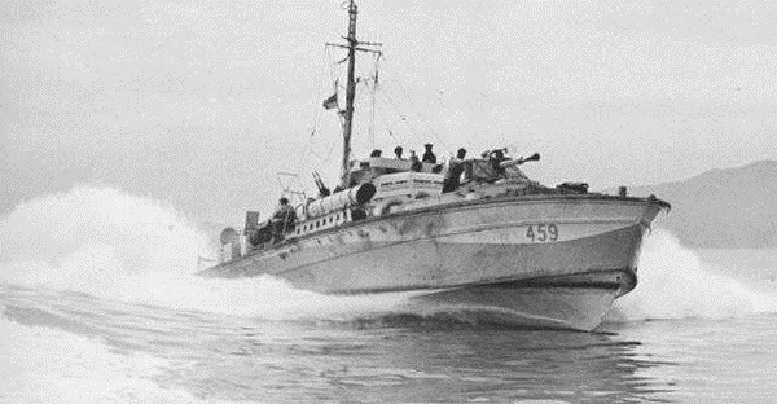
One of the vessels that was developed during the war for operations in what can be called the Battle of the Narrow Seas which was the English Channel, the area between South England to the Bay of Biscay and the North Sea was the Motor Torpedo Boat. This fast small racehorse was intended to attack German convoys transiting up and down the occupied coast and to protect allied shipping. Most operations were conducted in during the night in order to avoid daytime attack by the Luftwaffe and use the dark to hide from more powerful Kriegsmarine ships.
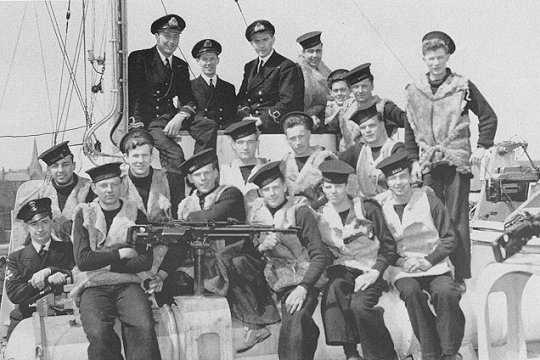
MTB 461, May 1944. (PA 176740)
Front row (left to right): Sig. Andy Clealand, RCNVR, of Toronto; O/S George MacDonald, RCNVR, of Verdun, Que.; A/B Sea. Torpedoman Gerald Thompson, RCNVR, of Toronto; Tel Beverley Bahledo, RCNVR, of Montreal; O/S Don Elliott, RCNVR, of Moose Jaw, Sask.
Second row: C.P.O. M.M. Robert McGee, RCNVR, of New Glasgow, N.S.; Stoker (M) George Abram, RCNVR, of Toronto; O/S Edwin McAuley, RCNVR, of Toronto; O/S A.A.3. Burt Sears, RCNR, of Shelburne, N.S.; O/S Sea.Torpedoman Garnet Workman, RCNVR, of Kemptville, Ontario.
On the Bridge: The Commanding Officer, Lieut. C.A. Burk, D.S.C., RCNVR, of Toronto; third officer, S/Lieut. Ian Robertson, RCNVR, of Winnipeg; first Lieutenant, Lieut. Keith Scobie, RCNVR, of Ottawa; coxswain, L/S Albert Stubbins, of Hamifton and Port Colborne, Ontario; unknown sailor; A/B A.A.3. Lawrence Jodain, M.I.D., RCNVR, of Edmonton; O/S Francis McLeod, RCNR, of St. John, N.B (with hand on hip).
Crew
- Captain – Lieutenant or sub-lieutenant
- First Lieutenant -Lieutenant or sub-lieutenant
- Coxswain – Petty officer or leading seaman Petty officer motor mechanic
- Leading stoker
- Able seaman – seaman torpedo man
- Able seaman – seaman gunner
- Telegraphist
- Stoker
.gif) Ship Information
Ship Information 
MTB 461
Builder: British Power Boat
Construction Started: 12 Mar 1943
Launched: 1944
Commissioned :1944
Pennant Number: MTB 461
Atlantic English Channel
Decommissioned :1945
Paid Off: Enter
Other ShipsMTB 461
SCOTT – PAINE TYPE G-TYPE
Built by - British Power Boats at Hythe.
Displacement: (New & Dry) – 47 tons
Displacement: 52 tons full load
Length: 71.5 ft (21.33 m)
Beam: ft in 20'7"
Draught: 5'9"
Propulsion: 3 Rolls Royce or Packard V-12 Supercharged 1250 H.P. engines, each with a 2,500 gallon capacity of 100% octane gas
Speed: 38 to 41 knots (43.7 /47.1 mph) at full load
Range: 140 miles while cruising at 25 knots
Compliment: 15 - 21
Armarments:
2 × single 6 pounder guns
two 10 inch Torpedo tubes
2 × twin .303 Vickers K guns
4 × light boat depth charges
Searchlight
TSA smoke generator
Other MTB
- Naval Museum of Manitoba
- Lambert, John. Fairmile D Motor Torpedo Boat. (Anatomy of the Ship series) 1985 ISBN 978-1-84486-006-7
- Colledge, J. J.; Warlow, Ben (2006) [1969]. Ships of the Royal Navy: The Complete Record of all Fighting Ships of the Royal Navy (Rev. ed.). London: Chatham Publishing. ISBN 978-1-86176-281-8.
- Douglas, W.A.B.; Sarty, Roger; Whitby, Michael (2002). No Higher Purpose: The Official Operational History of the Royal Canadian Navy in the Second World War, 1939–1943 Volume II, Part I. St. Catharines, Ontario: Vanwell Publishing. ISBN 1-55125-061-6.
- Macpherson, Ken; Barrie, Ron (2002). The Ships of Canada's Naval Forces 1910–2002 (Third ed.). St. Catharines, Ontario: Vanwell Publishing. ISBN 1-55125-072-1.
- http://www.nauticapedia.ca/dbase/Query/Shiplist4.php?&name=Agassiz%20%28H.M.C.S.%29&id=965
- Schull Joesph, Far Distant Ships, An official Account of Canadian Naval Operations in World War II, Stoddart Publishing: Toronto. 1989
Cite Article : Reference: www.navyhistory/sections/Ships/Minesweepers/HMCS_Courtenay.html
Source: NA

